AI Agent Manages My Grocery List — What AI Strategy Actually Looks Like
Most AI strategy conversations stay at the framework level. I wanted to see what the actual stack looks like when agents have to reason, decide, and act on real consumer apps.
What This Actually Is
A working proof of concept for AI agents that manage recurring operational tasks. The agent:
- Reasons across purchase history data to determine what matters
- Makes decisions — reorder now vs. wait — without a human in the loop
- Executes against a real consumer app, not a sandbox API
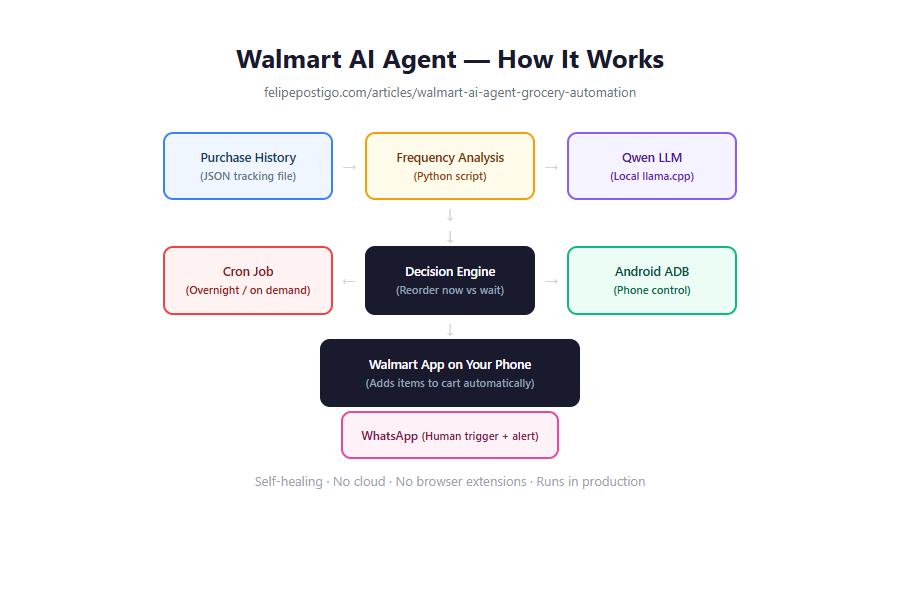
The system runs on Android ADB as the execution layer, a local LLM (Qwen) for orchestration, and purchase frequency analysis that drives when the agent acts. It's cron-scheduled, self-healing, and has been running in production for months.
The Stack
No cloud dependencies. No browser extensions. No human intervention once it's set up.
- Execution: Android ADB — the agent literally opens the Walmart app on my phone and adds items to cart
- Orchestration: Local LLM (Qwen 3B) running on my machine — no API costs, no latency
- Brain: Purchase frequency analysis — tracks how often I buy each item, calculates when I'm likely to run out, triggers a reorder before I even think about it
- Scheduler: Cron jobs that run overnight or on demand via WhatsApp
- Self-healing: The cron job detects failures and auto-restarts the LLM server if something goes wrong
What This Means for AI Strategy
The strategic point is simple: the people who will define AI strategy in the next 2-3 years are the ones already running agents against real systems — not just evaluating vendors from the outside.
Reading about agentic AI and actually having a cron job that adds milk to your cart because it knows you bought it 12 days ago are completely different things. The gap between the framework conversation and the actual execution is where the real learning happens.
This is why I built it instead of just writing about it.
If You're in AI Strategy or Agentic Automation
If you're hiring for AI strategy, AI operations, or agentic automation leadership — or if you're working on this and want to compare notes — I'd love to hear what you're building.
The full technical walkthrough drops soon. But the strategic point stands: get your hands dirty with real systems.
FAQ
How does the agent decide when to reorder?
It tracks purchase frequency for each item. If you bought bananas 12 days ago and you typically buy them every 10 days, it flags bananas as nearly due. When the urgency score crosses a threshold, it adds them to cart automatically — no human prompting needed.
Does it use the Walmart API?
No. It uses Android ADB to control the Walmart app directly on the phone. This means it works with the actual consumer app just like a human would — no API keys, no developer access, no sandbox.
What happens if something goes wrong?
The cron job has self-healing logic. If the LLM server crashes, it restarts automatically. If the ADB command fails, it logs the error and alerts via WhatsApp. It doesn't just silently fail — it tries to fix itself first.
Is this running all the time?
The agent is always running in the sense that the cron jobs are scheduled. The LLM server sits idle until a job fires. It uses WhatsApp as the human-facing interface — I send it a message, it works on the task, and notifies me when it's done.
What's the actual tech stack?
Hernes (agent framework by Nous Research), Qwen 2.5 3B running locally via llama.cpp, Android ADB for mobile execution, purchase frequency analysis in Python, cron for scheduling, WhatsApp bridge for messaging. No cloud AI services, no browser extensions.